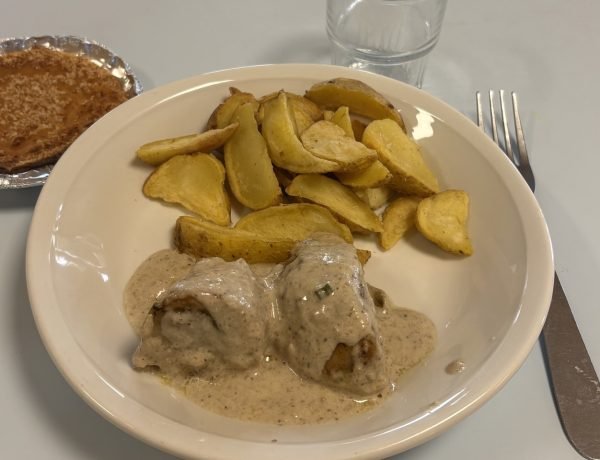
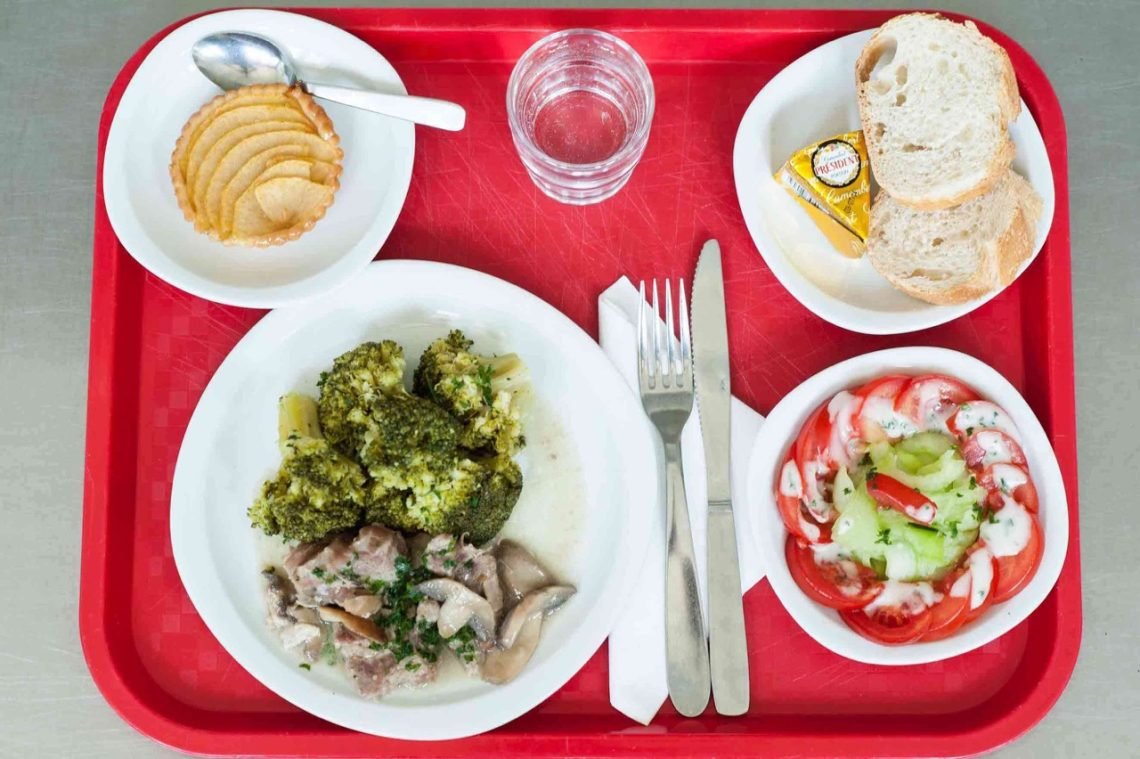

French school lunches at elementary schools usually last about 40 minutes, followed by 40–50 minutes of outdoor recess. The mid-day break is long compared to many other countries. Yes, part of that time is because French school cafeterias serve a sit-down, multi-course meal (first course, main course, cheese, dessert).
But the length of the French school lunch break is about much more than the food. Here’s why the French invest so much time and energy into the school lunch experience.
If you’re new here and want the full picture of how French school lunches actually work – from menus to culture to regulations – I wrote a complete guide here → French School Lunches: How They Work Today.
And if you’re curious about what happens behind the scenes – how the food is cooked, sourced, and prepared – this deep dive into the cantine kitchen will give you the full story → Inside A French School Cafeteria Kitchen.
1. A Reinforced Cultural Norm
One of the most important wellbeing habits in France is simply this: sitting down to eat a full meal at a table.
Elementary school cafeterias are designed to look like a restaurant. Children sit at small tables of 4–8, and everyone eats the same meal from the daily fixed menu (with accommodations for allergies). The meal is served in courses, which naturally slows the pace.
Children aren’t unwrapping packed lunches or eating quickly before running out to play. They’re practicing the rhythm and pleasure of a real meal—something deeply rooted in French culture.
They’re also learning to fight against food waste, you can read more here → How France Is Working To Eliminate Food Waste.
2. Food Is Education
French school lunches are considered a core part of education—not an interruption to it.
For example, a 2001 French government text explains it clearly:
“One can often neglect or forget the educational aspect of the meal… Children learn eating habits at an early age. It is therefore important to start nutrition education while behaviors and attitudes have not already been established.”
The same document emphasizes teaching children to:
- recognize food groups
- develop their sense of taste
- make thoughtful food choices
- understand the impact of diet on health
The cafeteria is essentially the country’s largest, daily classroom for wellbeing.
The government establishes guidelines that every elementary school must follow. You can read about them here → French School Lunch Nutritional Guidelines Explained.
3. Socializing Matters
The French view mealtimes as a moment to eat well and connect with others—the two go together.
Again, from the same government text:
“Lunchtime is not only the intake of calories. It is also a moment when students… can relax and exchange socially with one another… Eating is a privileged moment of discovery and must remain a pleasurable moment.”
Thus, meals are not meant to be rushed. They’re meant to be enjoyed—with others.
4. A Necessary Pause in a Hectic Day
School in France is academic, structured, and intense. For instance, the school day is long (8:00–12:00 and 1:30–4:30). The mid-day break is designed to give children a real pause—time to reset, breathe, and play outside.
So, the extended lunch + recess isn’t a luxury. It’s built into the school day as a wellbeing tool.
5. Ensuring All Children Eat Well
And finally, one of the most impressive aspects of the French school lunch program is its universality. The same national standards apply to every public elementary school—wealthy or disadvantaged, large or small.
Children across France sit down to:
- four-course meals
- nourishing food
- at least 50% organic or local ingredients
Thus, the goal is clear: every child, regardless of background, should eat well and learn to enjoy a wide variety of flavors.
If you want to see the breadth of flavors have a look at this typical menu.
More From France
If you’re curious about how France nurtures healthier habits — from school lunches to everyday food, movement, and wellbeing — I share practical tips and stories each month. Sign up for the free newsletter below and receive my guide, The French Guide to Everyday Wellbeing, straight to your inbox. Merci!